SIG EV Questionnaire
SIG Evolution (SIG EV) is the cloud-based evolution of the SIG Questionnaire, built to modernize how TPRM teams conduct, manage, and track third-party risk assessments.
The SIG is available as a standalone product subscription and is included with all levels of Membership.
Interested in multi-year pricing? Email sales@sharedassessments.org.

SIG Evolution (SIG EV)
Building on nearly two decades of SIG leadership, SIG EV delivers a secure, web-based SaaS platform that simplifies assessment creation, collaboration, grading, and validation, while aligning with current regulatory expectations and industry guidance. .
Key capabilities include:
- Intuitive Web Interface — Create, compare, and score assessments with ease
- Secure Sharing — Distribute assessments via one-time links, no portal needed
- Live Dashboards — Track assessment progress at a glance
- Built-In File Validation — Capture and organize vendor responses in one place
- Role-Based Access — Appropriate permissions for every team
Want to learn more? Request a demo here, or explore our frequently asked questions here.
Already a member? Email membership@sharedassessments.org to review and sign terms for SIG EV and access your products through your Member Portal.
Modernized Vendor Assessments
SIG EV builds on the trusted SIG framework to deliver a centralized platform for creating, distributing, and reviewing third-party risk assessments. Guided workflows promote consistency and completeness, while built-in review tools make it faster to identify gaps and evaluate risk — all without the manual overhead of email-based file management.
Direct Mappings:
Widely Accepted Regulations, Frameworks and Industry Guidance
The SIG aligns with the most updated domestic and international regulatory guidance and industry standards for risk management. Since its inception, the SIG has been regularly updated for emerging global risks, regulations, guidelines, and standards for a wide range of industries.

Technology Standards & Frameworks
Shared Assessments SCA 2026
ISO 27001:2022
ISO 27002:2022
ISO/IEC 27701 PIMS A 2019
ISO/IEC 42001:2023
NIST Artificial Intelligence 100-1 2023
NIST SP-800-161r1 2022
NIST SP-800-53r5.1.1 (Nov 2023)
NIST SP-800-171r3 (May 2024)
NIST Cybersecurity Framework (Apr 2018)
NIST Cybersecurity Framework 2.0 (Feb 2024)
NIST Privacy Framework (Jan 2020)
Cybersecurity Maturity Model Certification (CMMC) 2.0 2024
CIS Critical Security Controls v8 2021
Regulations, Statutes & Laws
Digital Operational Resilience Act Jan 2023 (DORA)
EBA Guidelines on Outsourcing Arrangements Mar 2019
EU GDPR 2016/679
EU NIS 2 Jan 2023
Interagency Guidance on Third-Party Relationships: Risk Management 2023
FedRamp May 2023
FFIEC CAT Tool May 2017
FFIEC IT Exam Handbook: AIO Jun 2021
FFIEC IT Exam Handbook: Business Continuity Nov 2019
FFIEC IT Exam Handbook: Mgmt Nov 2015
FFIEC IT Exam Handbook: Outsourcing Jun 2004
HIPAA Administrative Simplification Mar 2013
NYDFS 23 NYCRR 500 Nov 2023
Industry Sector Guidance
CSA CAIQ 4.0 Jun 2024
CSA Cloud Controls Matrix v4
BRC Operational Resilience Framework Nov 2022
ISA 62443-4-1 and 2 2018
North American Electric Reliability Corporation (NERC)
PCI DSS 4.0 March 2022
Learn about the regulations, standards, and guidelines to which the SIG currently (and historically) maps here >>
What’s Included In The SIG Questionnaire?
After purchasing the SIG, you will be able to immediately download the product and supporting materials.
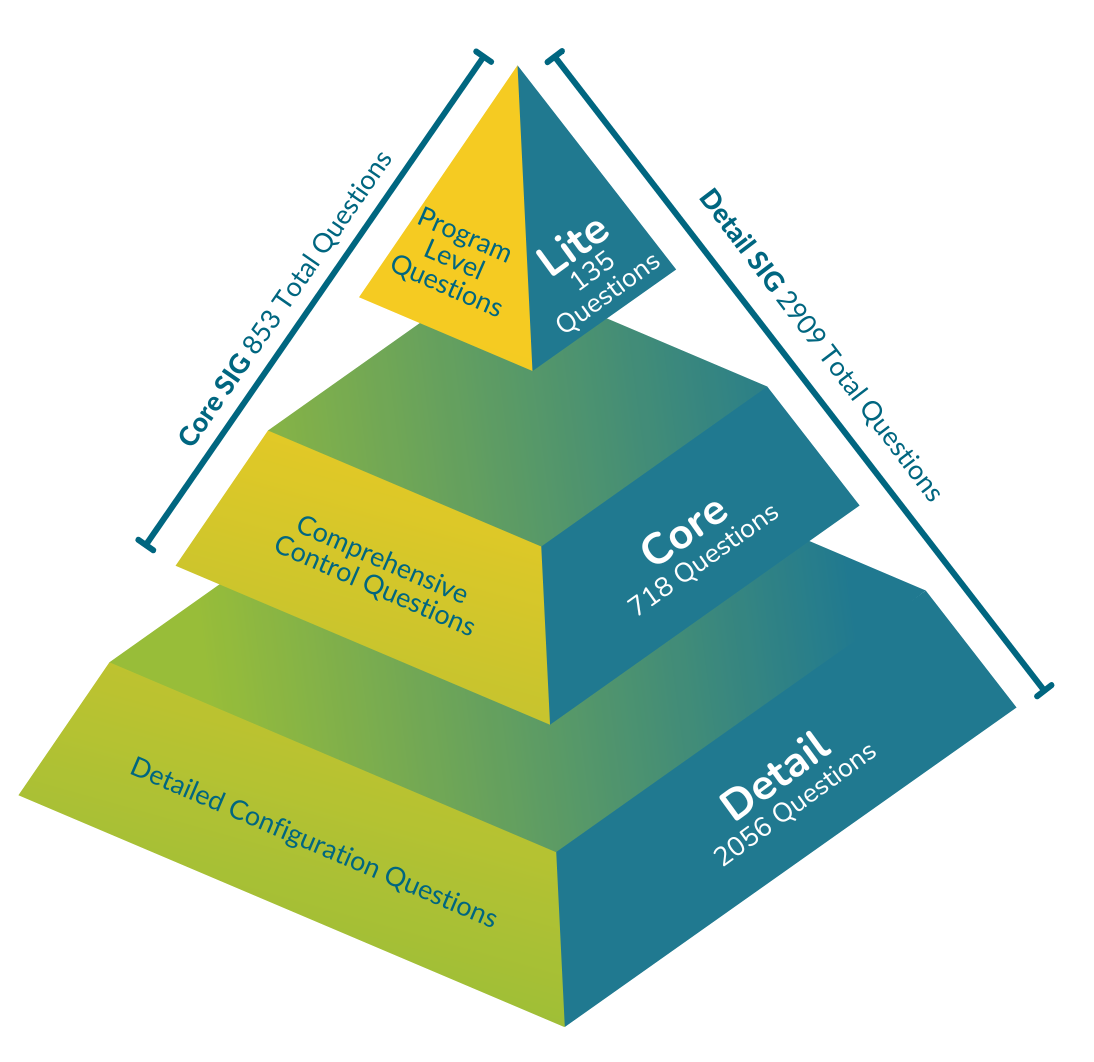
Learn more about which SIG you should use when scoping vendor risk questionnaires.
SIG Product
The SIG product itself (includes the SIG Manager).
SIG User guide
The SIG User Guide provides a summary of the action steps to create, analyze and manage SIG questionnaires.
SIG Manager Enhancement Document
This document covers the changes and revisions to the most recent version of the SIG.
SIG Version Delta
A workbook listing versions of the SIG from 2008 onward displaying the associations between question numbers, serial numbers, and identifying if a question is new or has been retired.
21 Risk Domains
The SIG measures security risks across 21 risk control areas, or “domains”, within a service provider’s environment.
- Access Control
- Application Management
- Artificial Intelligence (AI)
- Asset and Information Management
- Cloud Services
- Compliance Management
- Cybersecurity Incident Management
- Endpoint Security
- Enterprise Risk Management
- Environmental, Social, Governance (ESG)
- Human Resources Security
- Information Assurance
- IT Operations Management
- Network Security
- Nth Party Management
- Operational Resilience
- Physical and Environmental Security
- Privacy Management
- Server Security
- Supply Chain Risk Management (SCRM)
- Threat Management