
NIST vs. ISO: What’s the Difference?
NIST vs. ISO: Key Differences and Choosing the Right Framework
Cybersecurity frameworks are the foundation of effective risk management. They help organizations protect sensitive data, maintain compliance, and build trust with stakeholders. Two of the most widely recognized are NIST (National Institute of Standards and Technology) and ISO (International Organization for Standardization).
While both provide structured approaches to managing cybersecurity risk, they differ in scope, applicability, and implementation. Understanding these differences is essential to selecting the right framework for your organization.
According to a Perforce study, 54% of organizations experience data breaches due to non-compliance. Choosing the right framework and applying it consistently can help reduce this risk and strengthen your overall security posture.
Overview of NIST and ISO Frameworks
NIST (National Institute of Standards and Technology)
NIST is a U.S. government agency that develops standards and best practices to improve cybersecurity across both federal and private-sector organizations. Its frameworks are known for being detailed, prescriptive, and highly actionable.
Common NIST Frameworks:
- NIST 800-53: Security and privacy controls for federal information systems.
- NIST 800-171: Protection of Controlled Unclassified Information (CUI) in non-federal systems.
- NIST Cybersecurity Framework (CSF): A voluntary guide to help organizations assess and improve their cybersecurity programs.
Together, these frameworks form a comprehensive toolkit for managing cyber risk, whether an organization operates within the federal ecosystem or the private sector.
ISO (International Organization for Standardization)
ISO develops globally recognized standards that provide a flexible, principle-based approach to information security. These frameworks focus on establishing repeatable, risk-based processes that can adapt to any industry or geography.
Key ISO Standards:
- ISO 27001: Establishes an Information Security Management System (ISMS).
- ISO 27002: Offers best practices for implementing security controls within an ISMS.
ISO standards are ideal for organizations seeking a consistent, globally accepted approach to cybersecurity governance.
Key Differences Between NIST and ISO
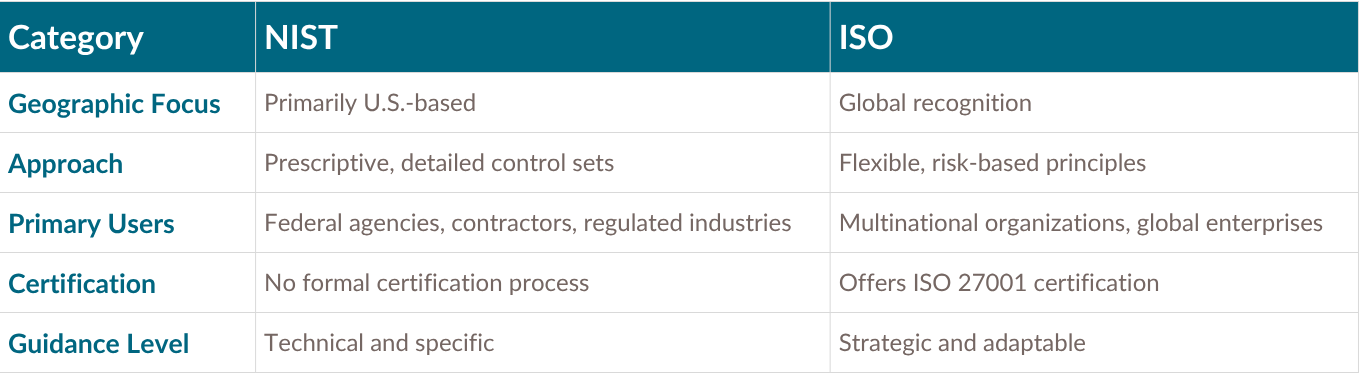
Both frameworks aim to reduce cyber risk — NIST through detailed implementation, and ISO through flexible, scalable standards.
NIST Cybersecurity Framework (CSF) and Maturity Model
The NIST Cybersecurity Framework (CSF) helps organizations identify, protect, detect, respond to, and recover from cyber threats. It also includes a Maturity Model that defines the progression toward cybersecurity resilience:
- Partial (Initial): Reactive, ad hoc security practices.
- Risk-Informed: Some risk management processes established.
- Repeatable: Policies and controls are consistently applied.
- Adaptive (Optimized): Continuous improvement and proactive resilience.
Advancing through these maturity levels enables organizations to strengthen their cybersecurity posture over time.
Achieving NIST CSF Alignment
To align with NIST CSF, organizations should:
- Assess current cybersecurity posture – Identify strengths and gaps.
- Implement recommended controls – Apply NIST guidance across key functions.
- Continuously monitor and improve – Maintain resilience as threats evolve.
When to Choose NIST vs. ISO
Choose NIST if you:
- Operate primarily in the U.S. or work with federal agencies.
- Require detailed, prescriptive security guidance.
- Handle Controlled Unclassified Information (CUI) or other regulated data.
Choose ISO if you:
- Operate globally and need international recognition.
- Prefer a flexible, risk-based framework.
- Seek ISO 27001 certification for credibility with customers and partners.
Many organizations integrate both frameworks — using NIST for technical rigor and ISO for global consistency.
How Shared Assessments Supports Framework Alignment
Managing multiple frameworks can be complex. Shared Assessments provides the tools and expertise to help organizations navigate compliance efficiently and confidently.
- Standardized Information Gathering (SIG) Questionnaire: The SIG maps to NIST, ISO, HIPAA, GDPR, and other leading standards, streamlining third-party risk assessments. Updated annually, it covers 21 Critical Risk Domains, ensuring comprehensive coverage of cybersecurity, compliance, and operational risk.
- Guide to Risk Domains: An essential resource outlining the 21 domains organizations must assess to maintain robust cybersecurity and compliance programs.
- Certified Third Party Risk Professional (CTPRP) Certification: The CTPRP helps risk professionals deepen their expertise in third-party risk management and stay current in an evolving regulatory landscape.
- Collaborative Industry Thought Leadership: Through our committees, working groups, and resources, Shared Assessments connects industry leaders to advance best practices in third-party risk management.
Building Resilience Through Frameworks
Compliance isn’t just about meeting requirements; it’s about building resilience and trust. Whether your organization aligns with NIST, ISO, or both, Shared Assessments can help you strengthen your cybersecurity and risk management strategies.
Connect with our team to learn how Shared Assessments can support your organization in achieving robust, framework-aligned compliance.
Login
Please register or log in to complete the checkout process. You will be redirected to the checkout page after logging in.
Feedback Agreement
By downloading this software, you acknowledge that you may be invited to provide usability feedback to help improve its functionality. Feedback does not guarantee changes or compensation.